

As the global population continues to grow and urban spaces become more crowded, traditional farming faces serious limitations. Limited land, unpredictable weather, and rising food demand are pushing agriculture to innovate—and one of the most revolutionary solutions is Vertical Farming.
Vertical farming allows crops to grow in stacked layers, often inside climate-controlled buildings using hydroponics, aeroponics, or aquaponics. It is transforming cities, making fresh food production possible anywhere—whether in warehouses, skyscrapers, or even basements.
In this blog, we explore the concept, benefits, technology, and future potential of vertical farming.
What Is Vertical Farming?
Vertical farming is a modern agricultural technique where crops are grown vertically in stacked shelves, towers, or multi-level structures. Instead of relying on sunlight and soil, vertical farms use:
- Artificial LED lighting
- Soilless systems (hydroponics, aeroponics)
- Automated irrigation systems
- Controlled temperature and humidity
This method ensures consistent growth throughout the year, regardless of external climate conditions.
Benefits of Vertical Farming
1. Maximum Production in Minimum Space
Compared to traditional farmland, vertical farming can produce 10–20 times more crops per square meter, making it ideal for cities and areas with limited land.
2. Year-Round Cultivation
Climate-controlled environments allow continuous harvests without seasonal delays, droughts, or storms.
3. 90% Less Water Usage
Hydroponic and aeroponic systems use recycled water, drastically reducing water consumption.
4. Zero Soil and Reduced Pesticides
No soil means no weeds, less disease, and minimal need for chemical pesticides.
5. Fresh Food Closer to Consumers
Vertical farms can be built near or inside cities, reducing transportation costs and ensuring fresher produce.
6. Lower Environmental Impact
Vertical farming reduces:
- Land use
- Water waste
- Greenhouse gas emissions
- Soil degradation
Technologies Used in Vertical Farming
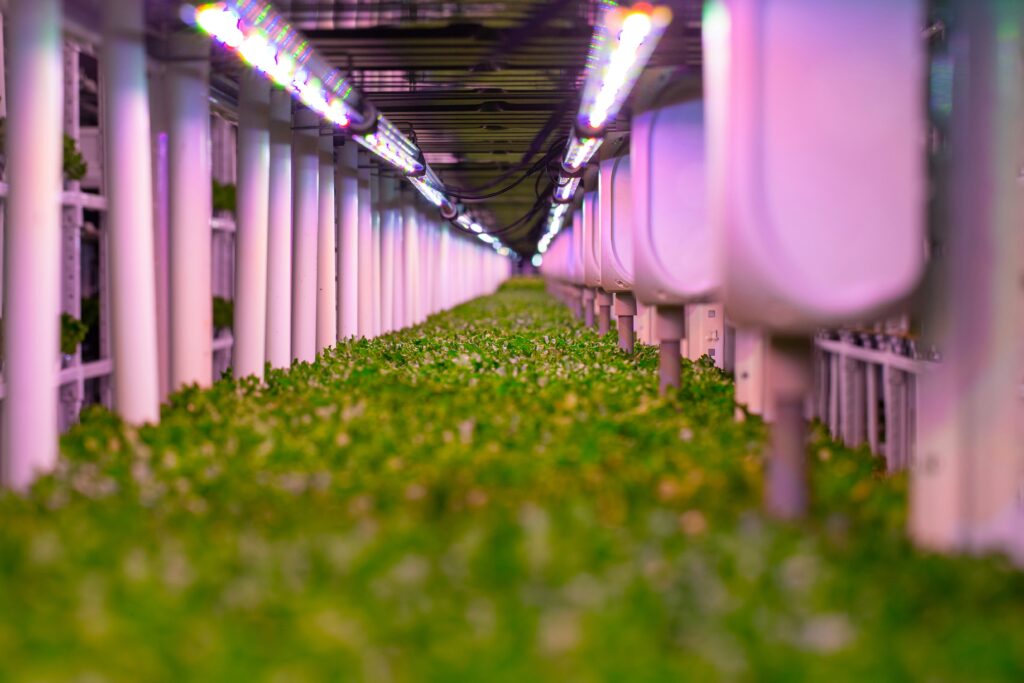
1. LED Grow Lights
LED lights provide specific wavelengths for optimal plant growth. They are energy-efficient and customizable for different crop stages.
2. Automated Climate Control
Sensors manage temperature, humidity, CO₂ levels, and airflow to maintain ideal conditions.
3. Hydroponics
Plants grow in nutrient-rich water without soil. Ideal for leafy greens and herbs.
4. Aeroponics
Roots are suspended in air and misted with nutrient solutions. This ensures maximum oxygen flow and rapid growth.
5. IoT and AI-Based Monitoring
Smart technologies track plant health, water usage, and nutrient levels, helping farmers make data-driven decisions.
Crops Suitable for Vertical Farming
- Lettuce
- Spinach
- Kale
- Microgreens
- Mint
- Basil
- Strawberries
- Tomatoes (in advanced systems)
Leafy vegetables and herbs grow fastest and provide the highest profitability.
Challenges in Vertical Farming
While promising, vertical farming also has challenges:
1. High Initial Investment
LED lights, automated systems, and controlled environments require capital.
2. Skilled Management Needed
Operators must understand both farming and technology.
3. High Electricity Use
Lighting and air conditioning increase energy requirements.
4. Crop Limitations
Currently more suitable for leafy greens than large staple crops.
Despite these challenges, costs are decreasing as technology improves.
Future of Vertical Farming
The future is extremely promising. With advances in renewable energy, automation, and seed technology, vertical farms may soon grow:
- Wheat
- Rice
- Corn
- Medicinal plants
Cities could produce their own food locally, reducing global supply chain pressures and increasing food security.
Conclusion
Vertical farming represents a major shift in agriculture—combining innovation, sustainability, and efficiency. As land and water resources become scarce, vertical farming offers a powerful, future-ready solution that brings food production closer to urban populations.
By embracing high-tech farming methods, we can ensure a greener, smarter, and more sustainable agricultural future.
Get daily agriculture blogs, tips, and updates:
👉 Join our WhatsApp Channel:https://www.whatsapp.com/channel/0029VbBz1Ni5vKAHRbmLNy45